
Ayon Spark V – Integrated amp – Hifi-Statement – September 2026
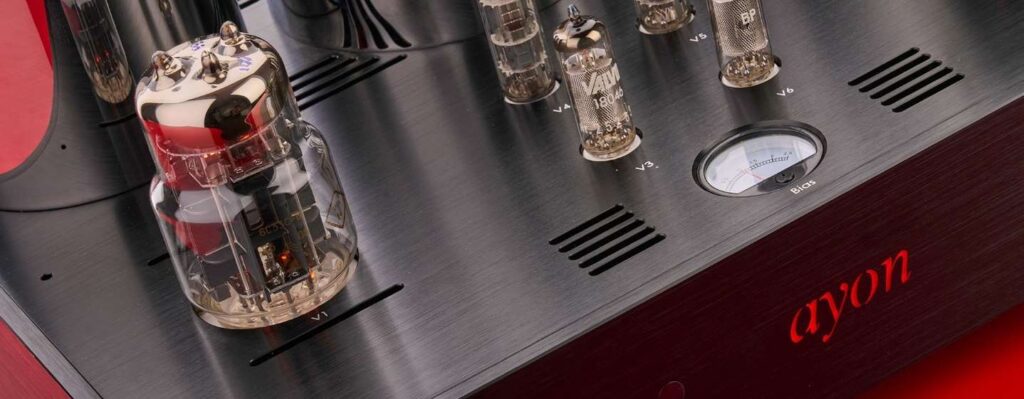
Ayon Spark V
August 25, 2026 // Carsten Bussler
The Spark integrated tube amplifier has been a permanent part of Ayon’s product portfolio for more than 20 years. Positioned more toward the entry-level end of the Austrian manufacturer’s range and nominally below the Evolution series, this amplifier has the potential to be a hidden champion thanks to its use of the Russian 6C33 triode.
At least since my review of the mighty Ayon Crossfire Evo, I consider myself something of an Ayon connoisseur, especially since I have listened to various other products from the brand over the years. The Crossfire Evo impressed me personally—and all of us at Hifistatement—so much that we awarded it the Statement in High Fidelity award in 2023. However, not everyone can or wants to spend five-figure sums on individual components, and anyone who knows me knows that I am always on the lookout for comparatively affordable candidates with the potential to outperform their much more expensive counterparts sonically.
A brief aside on Ayon’s company history: Ayon Audio is one of Austria’s renowned high-end hi-fi brands and is closely associated with the name Gerhard Hirt. The company’s roots date back to the early 1990s. Hirt, who had been fascinated by tube technology since his youth and became self-employed in 1990 with the hi-fi distribution company Living Sound, began developing his own tube amplifiers in Italy under the Vaic Audio brand in 1993. In 1999, the company was renamed Ayon Audio and amplifier production was moved to Austria. Hirt pursued a consistent strategy: in order to exercise greater control over quality and development, he took over parts of the former Alesa-Vaic tube manufacturing operation in Prague and worked, among others, with a former Tesla tube engineer. Over the following years, Ayon evolved from a tube amplifier specialist into a broadly diversified high-end manufacturer offering preamplifiers and power amplifiers, CD players, DACs, streamers and loudspeakers.
This brings me to the core of the brand and the subject of this review, the Ayon Spark V integrated tube amplifier. The “V” in the model designation indicates that this is now the fifth generation of a product that first appeared in the hi-fi world more than two decades ago. I am fortunate enough to usually be able to choose the equipment I review, and because of the highly interesting, if sometimes supposedly temperamental, Russian 6C33 triode, I chose the €7,000 Ayon Spark V. Speaking of “comparatively affordable”: of course, €7,000 is by no means a trivial amount in absolute terms, but within the world of Ayon it can still be considered moderate.
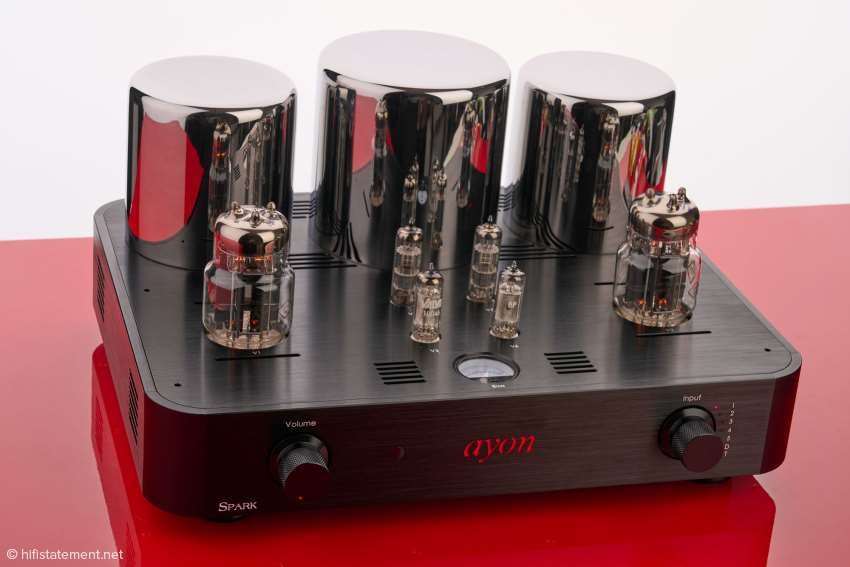
Typical Ayon: imposing presence, perfect workmanship and unmistakable styling are essential characteristics of this brand’s design, giving it an exceptionally high degree of recognition.
The thick and powerful 6C33 glass tubes are often used elsewhere because of their technical characteristics in so-called OTL amplifiers (Output Transformer Less), meaning circuits that dispense with the output transformers normally used in tube amplifiers and which, in terms of available output power, tend to resemble transistor amplifiers. Personally, however, neither the technical complexity required for this nor the resulting overkill in output power appeals to me. The ultimate path to superior sound remains the use of a Single-Ended Triode (SET) circuit. And this is where the decisive advantage comes in: while its more delicate 300B, 2A3 and similar counterparts are capable of no more than around eight watts of output power, the 6C33 can deliver up to 18 watts to the speaker terminals. In an SET circuit, mind you. This opens up a much wider range of potential loudspeaker partners for this tube—provided, of course, that the manufacturer knows how to make this special tube sound good. More than one manufacturer has failed at this, but if there is anyone I trust to get it right, it is Ayon!
A brief technical excursion into the 6C33: this dual triode, also known as the “Warthog,” was extremely popular in DIY circles during the 1990s and 2000s. Unlike, for example, the 845 triode, which can typically deliver 15 to 23 watts in Class A operation and therefore falls within a similar power range to the 6C33, the latter requires a significantly lower operating voltage and therefore allows for a simpler technical implementation. In addition, it acquired legendary sonic qualities associated with the following authentic-sounding story, although I was unable to locate any primary sources for it online:
Around 1976, a Russian pilot is said to have defected to Japan in his MiG-25 fighter jet. Western military experts examined its technology and discovered the previously completely unknown 6C33, a dual triode with parallel-connected electrodes and separate heater filaments that was extremely rugged and resistant to electromagnetic pulses (“EMP-resistant”). It has a transconductance of 40 milliamps per volt with an internal tube resistance of less than 100 ohms, which is extraordinarily remarkable for a triode. There was no comparable tube in the West at the time, and there still is not today.
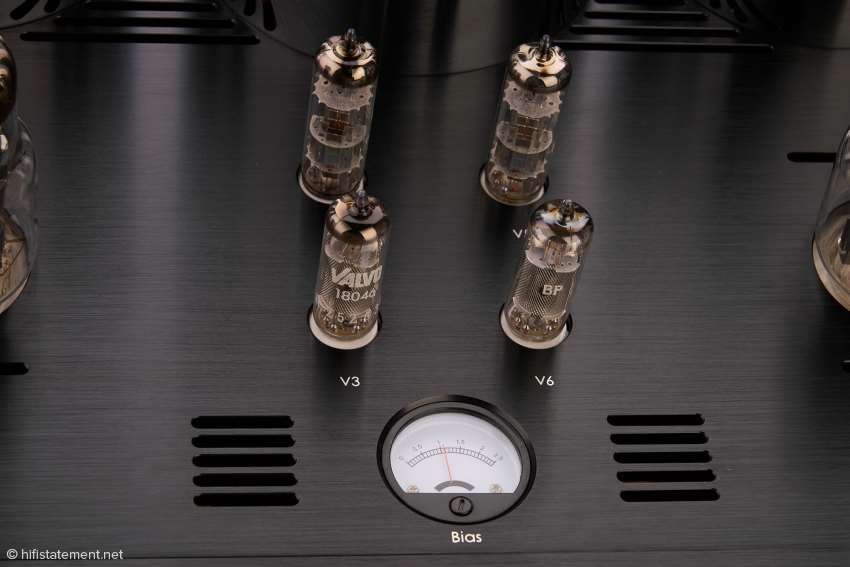
At the front are the two Valvo 18046 input tubes, low-frequency power pentodes developed for the German postal service. Behind them are the two PCL86 combination tubes, each incorporating a triode and pentode system, used here as driver tubes.
This rugged military-purpose tube was manufactured at the Russian Ulyanovsk tube factory and never appeared in significant numbers for audio applications. Instead, the DIY market was later flooded with consumer versions from Sovtek and Svetlana. In terms of quality, they were simply inferior, with slightly different parameters compared with the military version. As a result, these tubes often had a relatively short service life, which earned the 6C33 a corresponding reputation. Needless to say, Ayon uses the military version of the 6C33.
The Ayon tube complement is completed on each channel by a highly interesting input tube, the IL861 or 18046, as well as a PCL86 driver tube. The 18046, used here as a NOS Valvo tube, is a professional low-frequency power pentode developed specifically for the German postal service’s long-distance telecommunications systems and for government agencies. It is regarded as a highly reliable specialty tube. The PCL86 is a combination tube, meaning an electron tube with a nine-pin Noval base that incorporates both a triode and a power pentode within a single glass envelope. It was formerly used primarily in the audio output stages of televisions and radios.
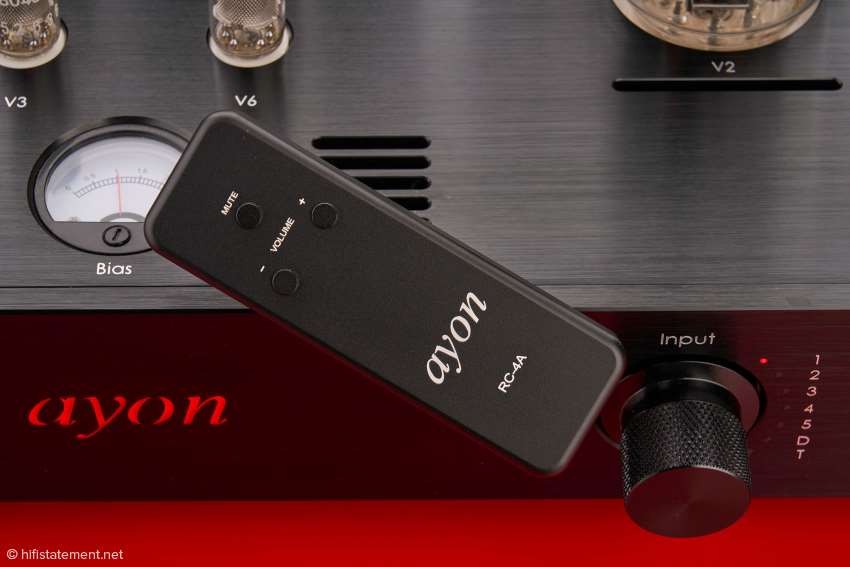
The minimalist remote control adjusts the volume and can mute the amplifier when required.
Overall, the design of the Ayon Spark V made a lasting impression on me. In terms of tactile quality and construction, there are few products in high-end audio that are comparably outstanding. Visually, I find the contrast between the chrome-plated transformer and power-supply covers and the deep black chassis particularly successful. Ayon’s design characteristics have remained consistent for 30 years, as Gerhard Hirt, Ayon’s owner and driving force, explained to me during a very friendly and entertaining telephone conversation. There are not only technical reasons for this, but strategic ones as well: the extraordinarily high recognition value contributes significantly to the success of the Ayon brand.
The Ayon Spark V is, in every respect, quite an imposing amplifier. The chassis measures 48 centimeters wide and 37 centimeters deep, and with a weight of 32 kilograms, it requires a large and sturdy platform. A substantial portion of this weight comes from the transformers and power transformer beneath the chrome-plated covers. Their iron cores are completely encapsulated in electronic potting compound to help prevent hum and vibration. The chassis itself is constructed from centimeter-thick machined aluminum components.
After switching on, the Spark V starts up through a timer circuit and only applies the anode voltage after the warm-up phase. This both protects the tubes and ensures that the entire process occurs without any unwanted noise. After switching on, there is silence. To detect any residual noise at all, I had to place my ear extremely close to the speaker drivers. That is fascinating for a Single-Ended Triode amplifier and demonstrates the technically immaculate design of the amplifier circuit.
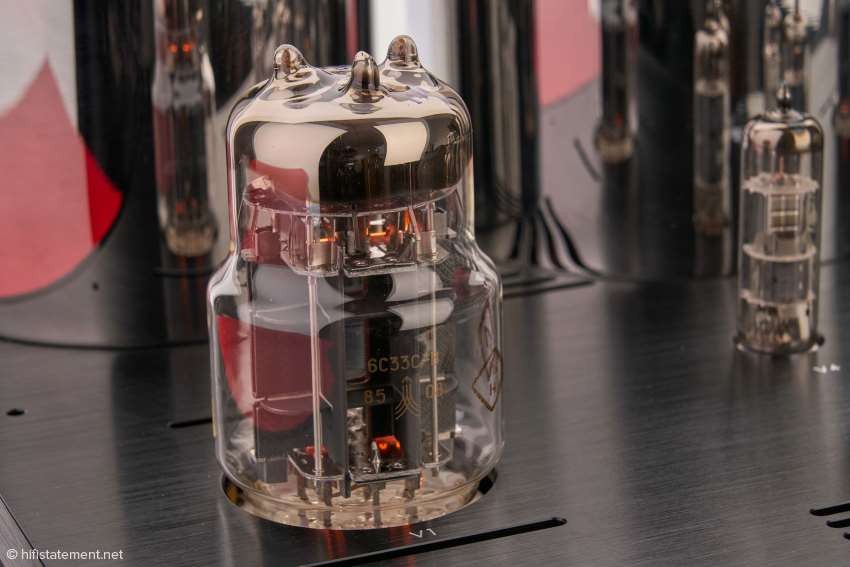
The heart and special attraction of this amplifier is the 6C33 dual triode with parallel-connected electrodes and separate heater filaments. This rugged NOS tube, developed for military applications, comes from the Russian Ulyanovsk tube factory.
What I heard next was equally fascinating. Every tone, every note, every softly breathed vocal seemed to be infused with an extra dose of energy that gave the music tremendous vitality. Not in an exaggerated way, but in an authentic one. Tonally, the Spark V played pleasantly neutral—in other words, neither too bright nor too dark. At all times I had the feeling that the amplifier could deliver even more when required. What impressed me most was the powerful, controlled and effortlessly agile bass range. Bass was always fast and fully defined, yet deep and substantial without ever becoming a lumbering steamroller. This kind of low-frequency substance is something even a 300B cannot deliver.
In many respects, the Spark V reminded me in character of the Ayon Crossfire Evo mentioned at the beginning. Without getting lost in details, I will try to summarize the essential differences: the Crossfire Evo is a little more meticulous in resolving the finest details and somewhat more commanding under extreme power demands, capable when necessary of delivering an almost merciless vise-like grip in the bass. The Spark V, on the other hand, impressed me with a little more effortless playfulness and its springy, colorful bass range. Ultimately, personal taste must decide.
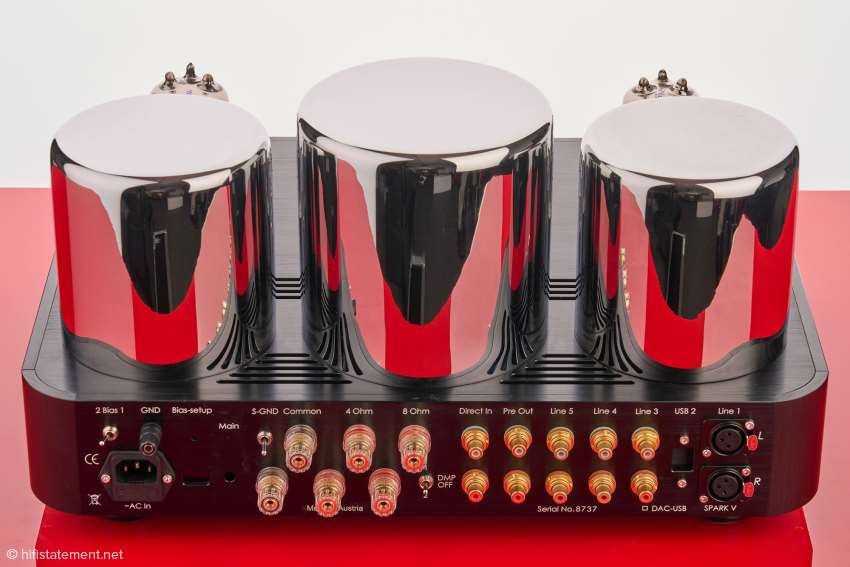
The wide range of connection options leaves little to be desired. Owners of 16-ohm loudspeakers should connect them to the 8-ohm terminals.
I always have difficulty describing specific musical examples. I would actually prefer to dispense with them entirely, because in my opinion they only provide a real benefit to readers who share my musical tastes. At the moment, as so often happens, I am in the mood for AC/DC—and pretty much my entire collection. Ultimately, I wish AC/DC had emphasized their blues-rock side even more strongly. Tracks such as “Ride On” (Dirty Deeds Done Dirt Cheap, Atlantic Records, 1976), “Down Payment Blues” (Powerage, Atlantic Records, 1978) and “The Jack” (T.N.T., Albert Productions, 1975) are timeless classics that never lose their appeal. The Spark V makes it abundantly clear just how incredibly energetic and alive Bon Scott’s singing was, with immaculately clean sibilants and tonal nuances in vowels, consonants and breathing sounds. Very few amplifiers are capable of reproducing this. Once again, I was painfully reminded of Bon Scott’s far-too-early death. And yes, when I wrote about the Crossfire Evo, I also said that I wished AC/DC had recorded an entire blues-rock album in this style.
Of course, the Spark V can handle lighter fare as well. I happened upon Coldplay’s album Viva La Vida or Death and All His Friends and the accompanying EP Prospekt’s March (both Parlophone, 2008). The interesting “Strawberry Swing,” embellished with hippie-like guitar sounds reminiscent of the late Beatles, is one of my favorite Coldplay songs. Played loudly, the track sounded extraordinarily colorful, with fine diction and perfect rhythmic accuracy. The bass drum drove the entire song, making it seem as though it had to pull a sleepily singing Chris Martin along behind it. Only first-class hi-fi components are capable of bringing such aspects to light.
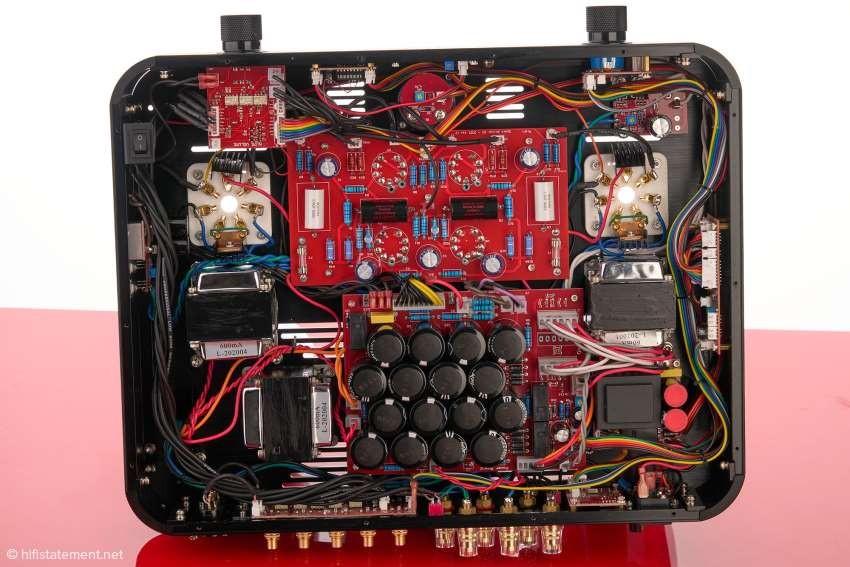
Hidden beneath the bottom cover is the exceptionally clean, circuit-board-based construction using very high-quality components such as Mundorf MCap Supreme capacitors. The classic blue ALPS potentiometer is used for volume control.
After blasting my increasingly thinning hair with rock music, it was time to calm things down again.
Dead Can Dance’s album Aion (4AD, 1990) did the job. Styled after Renaissance music, it includes pieces with Gregorian chant and traditional songs featuring medieval instruments such as the hurdy-gurdy and bagpipes. Here, tonal purity and fine rather than large-scale dynamics are especially important. Once again, the Ayon showed no weaknesses. The most subtle sibilants and vowels in the vocals sounded almost startlingly realistic. The historical instruments also played with tremendous tonal richness and naturalness, while the finest sonic details were resolved with great clarity and allowed to decay in finely delineated detail. This was truly spectacular and once again gave me goosebumps because of the extremely realistic portrayal of the instruments.
Ultimately, the Ayon Spark V should be considered sonically alongside rather than below its more expensive siblings. For me, this is an amplifier with which one could easily grow old, and one that would rarely, if ever, create the desire to seek out a larger, more expensive and supposedly better component in this category.
STATEMENT
The Ayon Spark V combines many of the sonic qualities of small Single-Ended Triodes such as the 2A3 or 300B while offering a significantly higher level of output power. For me personally, this is an amplifier for the proverbial desert island. Tube technology itself plays only a secondary role here. Every serious music lover should hear this amplifier at least once with suitable loudspeakers offering an efficiency of approximately 90 decibels or higher. The Ayon Spark V is a technically mature product refined down to the smallest detail, delivering authentic, engaging and long-term enjoyable music reproduction at the very highest level.
Associated Equipment
Phono Preamplifier
Pro-Ject Phono Box S2 Ultra with Pro-Ject Accu Box S2
Turntable
Pro-Ject Debut PRO + Record Puck PRO
Cartridge
Pro-Ject Pick it PRO
Loudspeakers
Various DIY full-range loudspeakers: Open Baffle (Ciare CH250), Transmission Line (Seas FA22RCZ & Seas Exotic F8), Tapered Quarter Wave Tube (Tang Band W8-1772), Backloaded Horn (Fostex FE206En)
Accessories
Dynamikks! Speakerlink I, Pro-Ject Connect-it RCA-E phono cable
Furniture
Hi-Fi Racks Ltd
Manufacturer Specifications
Ayon Spark V
Device Type
Integrated Tube Amplifier
Tubes
2 x 6C33, 2 x PCL86, 2 x IL861/18046
Mains Voltage
230V AC / 50 Hz
Inputs
3 x Line (RCA), 1 x Line (XLR), 1 x Direct-In
Input Sensitivity
350 mV
Outputs
1 x Pre-Out
Input Impedance
100 kOhm (@ 1 kHz)
Speaker Output Impedance
4–8 Ohms
Frequency Response
12 Hz–28 kHz (-3 dB)
Output Power
2 x 18 Watts
Equipment
Metal Remote Control
Circuit
Single-Ended, Class A
Chassis Color
Black, with chrome-plated covers for the transformers and output transformers
Front Panel
Black
Dimensions (W x D x H)
48 x 37 x 25 cm
Weight
32 kg